

If you live in Southwest Washington, you accept a few fundamental realities. First, “sunshine” is mostly a seasonal myth concocted to lure tourists. Second, Mount St. Helens is always watching. And third, from the rolling Willapa Hills down to the banks of the Chehalis River, the weather forecast for eight months of the year is simply: Wet.
While this perpetual dampness is a blessing for our ancient firs, lush berry fields, and world-class agriculture, it creates a terrifying reality for anyone running a food processing plant, craft brewery, or farm packing facility.
To bacteria, fungi, and biofilm, Southwest Washington isn’t just a location—it’s a five-star luxury resort with an open bar.
Enter the unsung guardians of the local palate: the commercial and industrial sanitation specialists. While the rest of us are casually sipping a double dry-hopped IPA or enjoying fresh local blackberries, these crews step into empty, damp facilities at midnight to ensure that the only thing in your food and drink is what the chef or brewmaster intended.
Here is a look at what it actually takes to keep SW Washington’s local food and beverage economy safe, sterile, and ridiculously delicious.
Part 1: The Listeria Chronicles (Or: Fighting Bacteria That Love Flannel)
Southwest Washington is an agricultural powerhouse. From berry packing houses in Lewis County to dairy processors and cold-storage facilities near Vancouver, food moves through our region at a staggering pace.
But our local climate presents a unique enemy: Listeria monocytogenes.
Unlike most bacteria that throw a fit and stop reproducing when temperatures drop, Listeria is a psychrophile—a sadistic micro-organism that thrives in cold, damp environments. In other words, if Listeria wore clothes, it would wear a rain jacket and feel right at home in a Chehalis packing warehouse in November.
       [ 45°F Rain Outside ]  --->  [ Cold Processing Floor Inside ]
                                             │
                                             ▼
                                  (Listeria's Dream Vacation)
The Industrial Counter-Offensive
When you’re processing tons of fresh produce or cold foods, you can’t just spray some disinfectant and hope for the best. Cross-contamination in a wet climate requires a combination of high-tech chemistry and brute-force discipline:
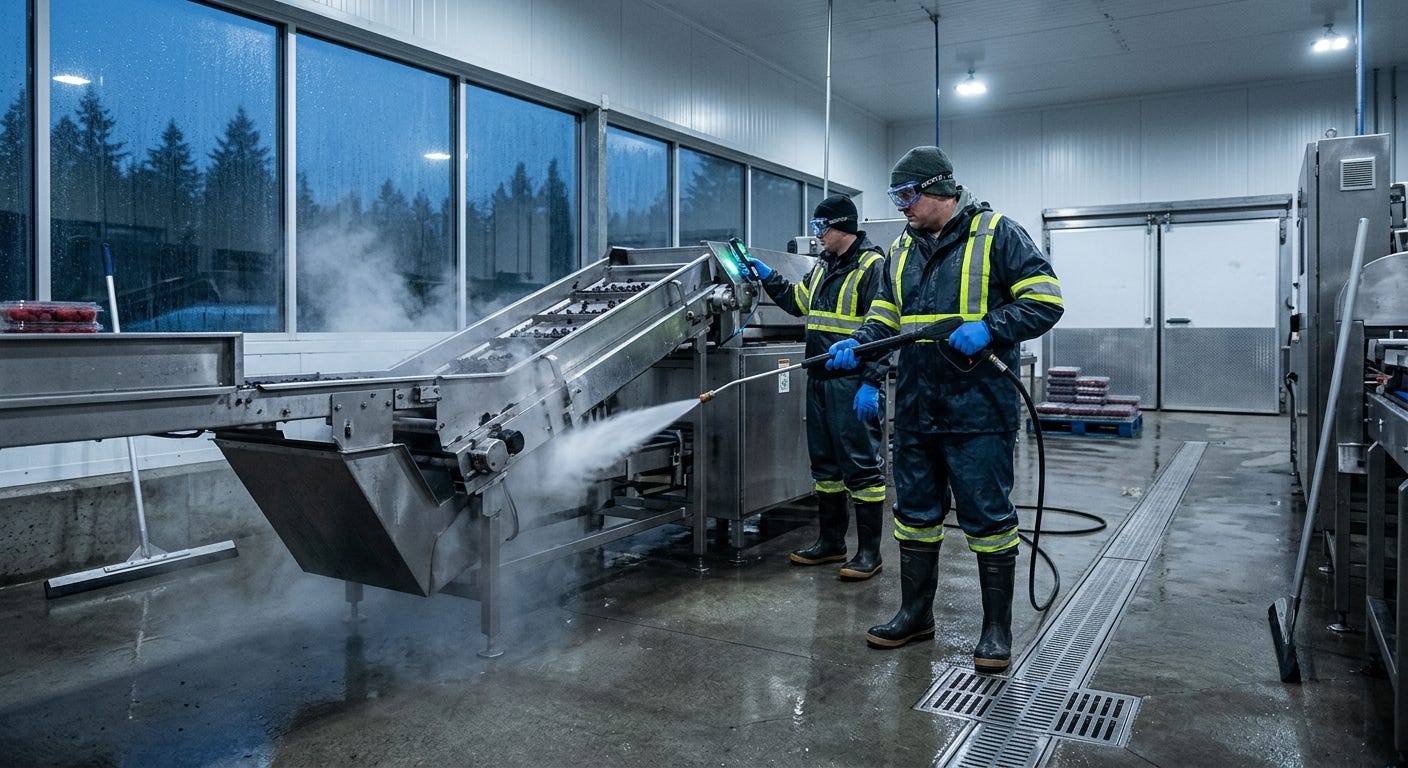
The War on Standing Water: In SW Washington, humidity hovers around “fish gills” for half the year. Sanitation crews must obsessively eliminate micro-puddles on concrete floors, around drain lines, and under conveyor belts where bacteria like to build microscopic cities (biofilms).
ATP Bioluminescence Swabbing: Before a line is cleared for production, technicians use real-time ATP swabs that detect cellular residue. If a surface lights up on the sensor, the team doesn’t just re-wash it—they go full nuclear with specialized bio-sanitizers.
Thermal Deep-Cleans: Steam-cleaning at temperatures that would make a geothermal vent blush, stripping away organic buildup in hard-to-reach mechanical joints without introducing chemical residue to fresh food.
Without these night-shift crews, local berry packing operations would grind to a halt under the weight of health department quarantines. They are the frontline defense keeping regional supply chains pristine.
Part 2: The Sacred Tank (Sanitizing Breweries and Wineries Without Ruining the Vibe)
If there’s one thing Southwest Washingtonians take almost as seriously as complaining about traffic on I-5, it’s our craft beverages. From small-batch wineries tucked into the Columbia River Gorge to bustling microbreweries in Thurston and Clark counties, the region is a haven for fermentation crafts.
Here’s the catch: Fermentation is just controlled spoilage.
A brewmaster’s entire job is to create a cozy, sugary paradise for one specific strain of cultured yeast. The problem? Every wild yeast spore floating in the damp Washington air wants to crash that party.
“If a sanitation crew messes up in an office building, the floor looks dull. If they mess up in a brewery, 500 gallons of craft IPA end up tasting like a wet wool sweater soaked in band-aids.”
The CIP (Clean-In-Place) Balancing Act
You can’t exactly climb inside a 30-barrel stainless steel fermentation vessel with a sponge and a bucket of soapy water. Industrial cleaning in the craft beverage sector relies on sophisticated Clean-In-Place (CIP) systems, executed with surgical precision.
[ Step 1: Caustic Wash ]  ──>  Strips organic proteins & hop resins
[ Step 2: Water Rinse  ]  ──>  Purges alkaline residue
[ Step 3: Acid Wash    ]  ──>  Dissolves "beer stone" (calcium oxalate)
[ Step 4: No-Rinse San ]  ──>  Kills wild yeast; leaves ZERO flavor signature
Stripping the “Beer Stone”: As beer ferments, it leaves behind a stubborn mineral crust called calcium oxalate (beer stone). If left unchecked, this rock-hard scale creates microscopic caverns where wild bacteria hide from standard surface sanitizers. Specialized acid washes are piped through spray balls at high pressure to dissolve scale without pitting the expensive stainless steel.
The “No-Flavor” Mandate: You cannot use scented cleaners, heavy chlorine, or anything that leaves a chemical footprint in a brewery or winery. Chemical residue will destroy the head retention on a stout or obliterate the delicate floral notes of a local Pinot Noir.
The Flavor-Neutral Wall: The final sanitizing agents must achieve a 99.999% microbial kill rate on contact, then break down into harmless, tasteless compounds before the next batch of wort hits the tank.
Respect the Night Shift
The next time you enjoy a crisp local cider, a fresh berry tart, or a pint of local pale ale while watching the drizzle hit the windowpane, take a brief moment to thank the unsung heroes of the regional economy.
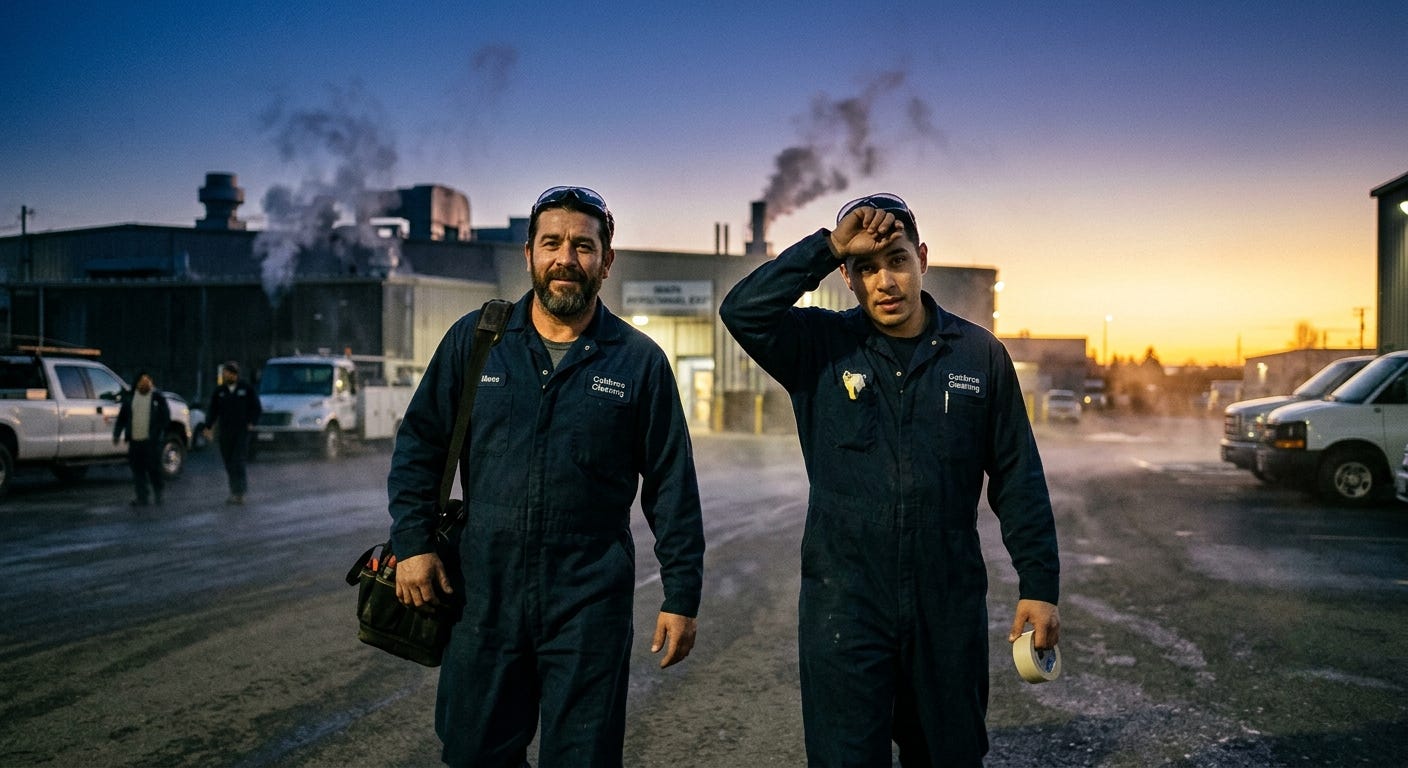
They aren’t wearing aprons or sommelier pins. They’re wearing waterproof boots, safety goggles, and high-visibility gear, wielding pressure hoses and chemical metering equipment in the dark hours of the morning.
In a region where the climate is constantly trying to turn everything back into a mossy rainforest, industrial sanitation isn’t just a maintenance task—it’s an art form that keeps Southwest Washington safe, prosperous, and exceptionally tasty.